Introduction
In the digital age, electronic evidence plays an increasingly vital role in litigation. From emails, text messages, and electronic banking data to surveillance cameras and GPS location data, digital evidence has become indispensable for proving cases in court. However, the legal framework for digital evidence in Vietnam remains under development, creating numerous challenges for practitioners in collecting, preserving, and utilizing this type of evidence.
This article provides an in-depth analysis of the legal framework, practical application, and strategic use of digital evidence in Vietnamese litigation.
1. Legal Framework for Digital Evidence
1.1. Civil Procedure Code 2015
The CPC 2015 recognizes electronic data as an evidence source:
- Article 94, Paragraph 1(e): Electronic data is listed as an evidence source.
- Article 95: Defines evidence from electronic data, including electronic data messages expressed in the form of electronic data exchange, electronic documents, email, telegraph, telegram, fax, and similar forms.
- Article 95, Paragraph 2: Electronic evidence is collected and preserved under the Law on Electronic Transactions.
1.2. Law on Electronic Transactions 2023
The Law on Electronic Transactions 2023 (effective from July 1, 2024) marks significant progress:
- Article 12: Legal value of data messages — not denied legal value solely because they are in data message form.
- Article 13: Data messages have the same value as written documents if content is accessible and usable for reference.
- Article 14: Data messages have original value if integrity measures exist from creation.
- Article 15: Provisions on the evidentiary value of data messages.
1.3. Criminal Procedure Code 2015
The Criminal Procedure Code 2015 also recognizes electronic data:
- Article 87, Paragraph 1(c): Electronic data is an evidence source.
- Article 99: Detailed provisions on electronic data, including data stored in computers, computer networks, electronic devices, and telecommunications networks.
- Article 107: Collection of electronic devices and electronic data.
1.4. Guiding Documents
- Resolution 04/2012/NQ-HDTP guiding the application of certain provisions on proof and evidence
- Joint Circular 10/2012/TTLT on seizure and preservation of electronic physical evidence
2. Common Types of Digital Evidence
2.1. Email and Electronic Correspondence
Email is the most common digital evidence in commercial disputes:
- Probative Value: Emails can prove the existence of agreements, negotiation processes, and breach notifications.
- Authentication Requirements: Must verify sender, recipient, time sent, and content integrity.
- Preservation: Print with notarial certification or archive with email service provider confirmation.
2.2. Text Messages and Messaging Applications
SMS, Zalo, Messenger, and Viber messages are increasingly utilized:
- Prove agreements, order confirmations, notifications
- Particularly relevant in labor disputes, divorce cases, and loan disputes
- Attention to metadata preservation (time, phone number, device) is essential
2.3. Banking Transaction Data
Account statements and electronic transaction histories:
- Prove payments and transfers
- Bank confirmations carry high evidentiary value
- Request bank-certified stamped copies
2.4. Surveillance Camera Data
Image data from security cameras:
- Widely used in criminal cases and traffic accidents
- Must be preserved promptly as data is typically overwritten cyclically
- Require verification of time, camera location, and ownership
2.5. Social Media Data
Posts, comments, images on Facebook, TikTok:
- Used in defamation and honor-damaging cases
- Prove relationships, behavior, and residence
- Content must be notarized before the opposing party deletes it
2.6. Electronic Contracts and Digital Signatures
Under the Law on Electronic Transactions 2023:
- Electronic contracts have legal value equivalent to paper contracts
- Authenticated digital signatures are equivalent to handwritten signatures
- Must verify the digital certificate was valid at the time of signing
3. Collecting and Preserving Digital Evidence
3.1. Collection Principles
- Integrity: Ensure data is not altered during collection (hash values).
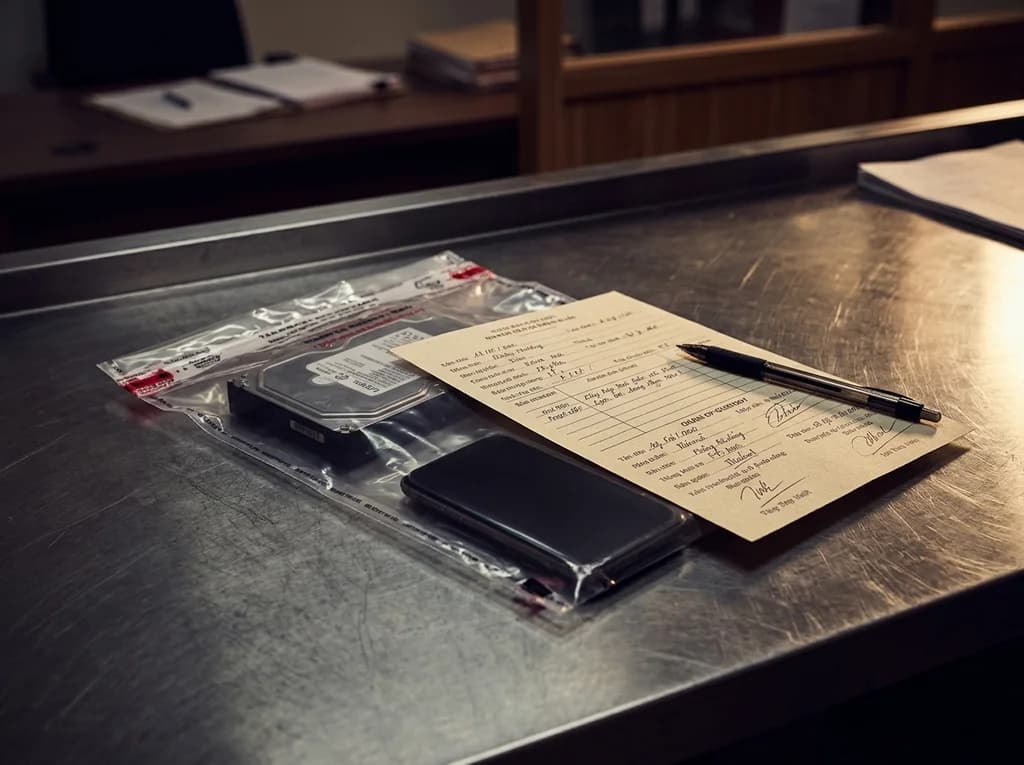
- Chain of Custody: Comprehensively document the collection, storage, and transfer process.
- Legality: Collect in accordance with legal provisions; do not illegally infringe on privacy.
- Timeliness: Collect immediately upon discovery to prevent deletion, overwriting, or loss.
3.2. Preservation Methods
Notarization of Electronic Content:
- Bring the device to a notary office for the notary to witness and create a record
- Notarize screenshots of emails and messages
- Note: Some notaries may be unfamiliar with electronic content notarization
Official Records via Judicial Bailiffs (Thua phat lai):
- Bailiffs create official records documenting content on electronic devices
- Official records have evidentiary value under Decree 08/2020/ND-CP
- This is the recommended method
Data Extraction from Service Providers:
- Request banks, telecom carriers, and email providers to furnish data
- Requires formal requests from courts or competent authorities
Digital Forensics:
- Engage digital forensics experts
- Extract deleted data, analyze metadata
- Particularly important in criminal cases
3.3. Mistakes to Avoid
- Taking only screenshots without preserving metadata
- Editing or splicing content before preservation
- Failing to document the chain of custody
- Illegal evidence collection (hacking emails, wiretapping)
4. Court Practice on Digital Evidence
4.1. Recognition Trends
Vietnamese courts increasingly accept digital evidence:
- Emails accepted as basis for contract formation
- SMS messages used to prove loans
- Surveillance cameras widely used in criminal cases
- Electronic bank statements accepted to prove payments
4.2. Challenges
- Lack of detailed regulations on technical preservation standards
- Limited judicial capacity for assessing digital evidence
- Difficulty verifying authenticity when the opposing party denies
- High digital forensics costs
4.3. Electronic Courts
Vietnam is implementing electronic courts, enabling:
- Online petition filing
- Online hearings via video conference
- Electronic case file management
This will strongly promote the acceptance and use of digital evidence.
5. Strategies for Using Digital Evidence
5.1. Initial Consultation Phase
- Instruct clients to immediately preserve digital evidence
- List all potential electronic data sources
- Assess collection feasibility and costs
5.2. Pre-Litigation Preparation Phase
- Create official records or notarize electronic content
- Request data from third parties (banks, telecom carriers)
- Prepare technical explanations for the judge
5.3. At Trial
- Present digital evidence visually and comprehensibly
- Be ready to explain technical terminology
- Have a technical expert on standby for support
- Challenge opposing party's digital evidence (verify integrity, authenticity)
5.4. Challenging Digital Evidence
When the opposing party presents digital evidence, examine:
- Was the collection process lawful?
- Is the chain of custody complete?
- Has the data been altered or spliced?
- Is metadata consistent with content?
- Can the source be verified?
6. Privacy Rights and Digital Evidence
Digital evidence collection must balance with privacy rights:
- Constitution 2013 (Article 21) protects correspondence and telephone secrecy
- Cybersecurity Law 2018 provides personal data protection
- Decree 13/2023/ND-CP on personal data protection
- Evidence collected in violation of privacy may be excluded by courts
Practitioners must ensure all digital evidence collection activities comply with personal data protection regulations.
7. Conclusion
Digital evidence has become an inseparable part of litigation in Vietnam. With the Law on Electronic Transactions 2023 and the judicial digitization trend, the role of digital evidence will become increasingly important.
Practitioners must equip themselves with information technology knowledge, master legal provisions on digital evidence, and develop skills in collecting, preserving, and presenting digital evidence. This is not merely a requirement of modern practice but a critical competitive advantage in the contemporary legal profession.